

I’ve spent a lot of time around Account Management teams over the years, and one thing I’ve become increasingly convinced about is that modern Account Management needs a rebuild. Somewhere along the way, the role became heavily associated with maintaining relationships, quarterly meetings, replying promptly to emails and “checking in” to make sure the customer is still happy. And for a long time, businesses have approached Account Management through some relatively simple engagement mechanics. Stack-rank the customer base, give them some weird name or internal categories, focus heavily on the top 20%, let marketing nurture the broader database and occasionally bring in a leader to strengthen engagement. And to be fair, there was a period when that simple approach worked pretty well. And perhaps doing business was a little simpler back then too.
The problem is that the modern customer environment has evolved well beyond that, and in my opinion, many businesses have intentionally or unintentionally lowered the commercial expectation of the role itself. In some organisations, Account Management has drifted too far toward administration, customer service, automation and relationship maintenance, rather than commercial influence, customer leadership and strategic growth. That may sound harsh, but I genuinely believe the bar needs to be raised. The modern customer environment has become far too competitive and psychologically dynamic to continue operating the old way. Customers are harder to win, harder to bed down and even harder to keep.
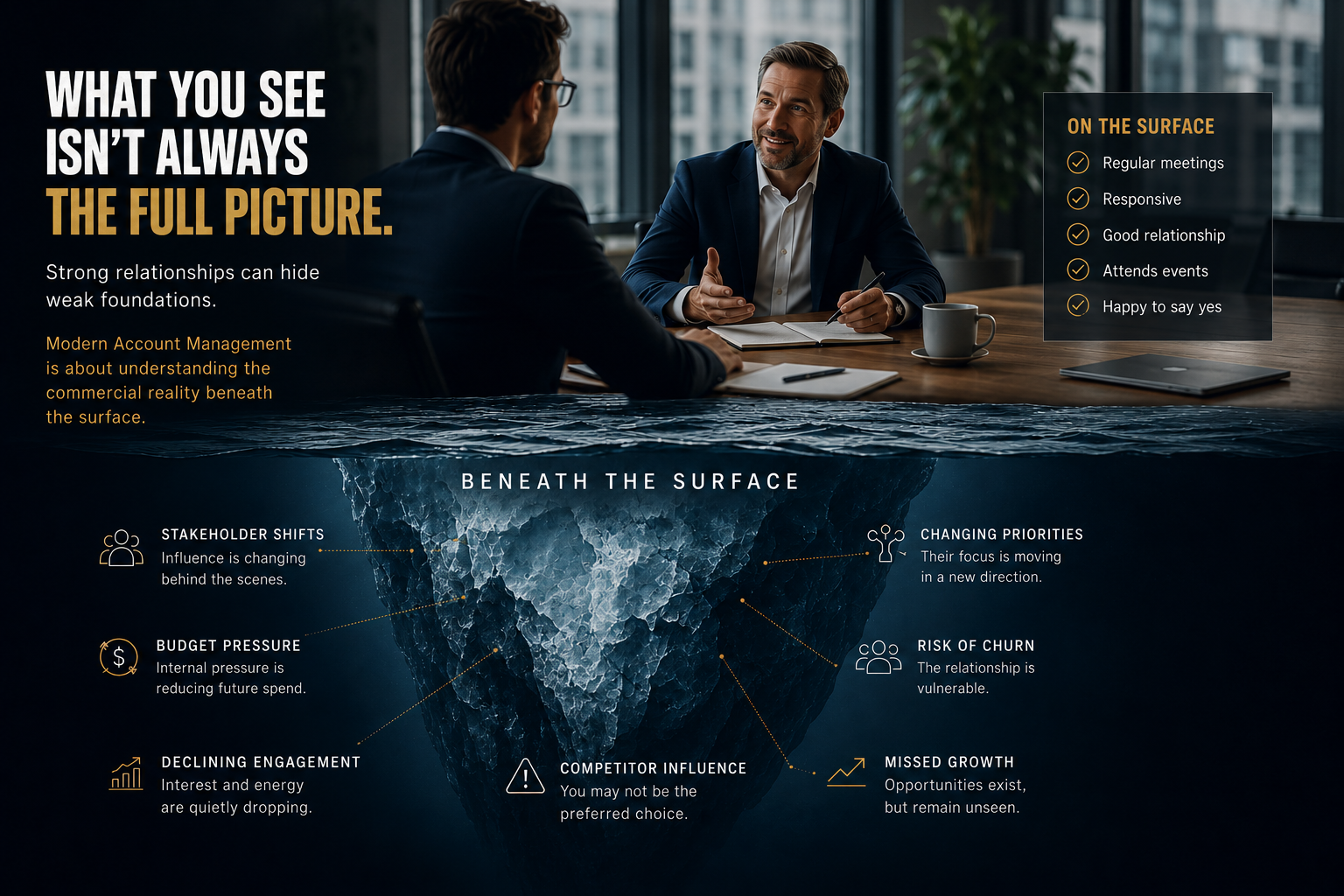
What makes this even more challenging is that good customer relationships no longer guarantee a supplier’s commercial security. I’ve seen AM’s have unbelievably strong personal relationships with customers and still be in danger of losing the account. A customer might smile or nod agreeably in meetings, respond quickly to emails, attend your events, be leading your footy tipping competition and you can still be halfway out the door. On the surface, the relationship appears healthy, whilst the commercial foundations underneath are slowly eroding and some AM’s are being completely blindsided.
“Many businesses remain completely unaware because they confuse relationship activity with commercial awareness.”
This distinction matters more than most managers realise because ‘customer activity’ can be incredibly deceptive. I’ve seen businesses with CRMs full of notes, meetings, follow-up tasks and account activity, but they still have very little visibility around what is actually happening inside the customer relationship. A lot of AM’s out there are being buried under operational noise – endless internal meetings, reporting, escalations, internal comms, customer admin, forecasting updates and reactive follow-up. Over time, their operational ‘busyness’ has started to replace any kind of strategic visibility or connection.
That, for me, is where the real shift in modern Account Management needs to occur. The best AMs I’ve seen almost operate like commercial psychologists. They understand stakeholder coverage and influence, buying behaviour, emotional drivers, problem clarity, commercial pressure, data trends, change events, ROI, decision dynamics, and they are aware of that healthy tension behind the scenes.
To that end, one of the things I’ve found most surprising over the years is just how many businesses still don’t have a structured way to assess the true commercial health of their customer relationships. They can almost always tell you who the customer is, what products they buy and when their current contract expires, but they struggle to explain where the relationship is vulnerable, where risk truly sits or where future growth may come from. That’s one of the reasons why Killer Consulting developed the Client Commercial Profile (CCP) engagement model.
Customer relationships are not static accounts to manage; they are living, breathing commercial environments that are constantly evolving, and the businesses that I see growing effectively are adopting the CCP method to understand the ‘current state’ of every single customer. And that’s why modern Account Managers are becoming commercially powerful. They are one of the very few resources you have at your disposal that can use ‘trusted’ sources to determine the current and future state of your business.
Once your Account Managers develop a deep understanding of the key characteristics, behaviours and dynamics of your strongest and most vulnerable customers, the business becomes far more capable of making informed Go-To-Market decisions. Your sales teams become far more targeted and commercially aware because they better understand what high-value, commercially aligned customers actually look like in practice. Marketing becomes more effective because messaging starts reflecting the behaviours, priorities and challenges of customers that genuinely engage and grow with your business.
In simple terms, better customer intelligence creates a better commercial strategy and the strength of a CCP comes from its ability to reflect reality.
The truth is, many of the biggest growth opportunities and risks inside customer relationships are not obvious on the surface. They sit quietly beneath the surface until they eventually reveal themselves in churn, disengagement, lost market share or declining revenue…and by then, it’s usually too late.
That’s why I believe the best Account Managers don’t “manage accounts” anymore, they understand the commercial reality behind the relationship, not just the relationship itself.
If you would like to learn more about the CCP model, contact Killer Consulting jamie@killerconsulting.com.au